
[Cine21] A Hallucinatory Landscape Formed on Temporal Disparities: Visiting the VR Trilogy Special Exhibition on U.S. Military “Comfort Women”
Published November 16, 2023 - Source
By Somi Kim

The Korean Film Archive has launched its first special exhibition on Immersive Media. Running from October 24 to November 18, “Your Silence is a Mirror – Gina Kim VR Retrospective” features Gina Kim’s VR short film trilogy — Bloodless, Tearless, and Comfortless — which evoke the sensory traces of the places once occupied by U.S. military “comfort women.” The trilogy is being screened in the Cinematheque KOFA’s lobby exhibition space. This rare opportunity allows audiences to experience her works across VR (Virtual Reality), AR (Augmented Reality), and XR (Extended Reality) formats. Kim’s new media projects guide viewers not toward the spectacle of the virtual—now increasingly overtaken by the gaming industry—but toward a re-sensualization of reality. From Bloodless (2017), which was met with critical acclaim upon release, to Comfortless (2023), which had its Korean premiere after competing at the Venice International Film Festival, this article records the day I connected with the preserved places and restored presences in Gina Kim’s VR films.
BLOODLESS / 2017

“Is the focus okay?” the exhibition staff asked while fitting the VR headset over my head. It felt slightly blurry, so I held the goggles with both hands and adjusted the height slightly. Only then did the view come into sharp focus. The staff tightened the headset so it would fit snugly against my eyes. A seemingly trivial moment—but in fact, a critical initial setting that determines the quality of the experience. Once the headphones covered my ears, I was completely cut off from the outside world and dropped into a quiet red-light district in the middle of the day. Bloodless, the first short film in Gina Kim’s trilogy about U.S. military camp towns, leaves the viewer alone in a state of utter estrangement, to briefly explore this unfamiliar place. Just as I began to adapt to the slight dizziness of VR while scanning my surroundings, night fell. Amid the lights, the sound of a woman’s high heels drew my attention, but her figure remained unclear. The film compels viewers to search for this anonymous woman themselves. With each change of scene, I was pushed deeper into increasingly narrow and dark alleys.
Virtual Reality, by allowing the viewer to look freely in all directions, could be seen as a medium that maximizes viewer agency. But because it narrows the protective distance between fiction and audience that 2D films naturally provide, it can also make one feel utterly defenseless. Eventually, I found myself trapped in the darkness, able to see only a sliver of light through an alley crack. The footsteps drew near, and I instinctively bowed my head as if reacting to a horror film—but instead of seeing my own knees, all I saw was the black floor of an alley in Dongducheon.
Viewers who previously believed the label “horror-like” was simply a metaphor for the social horror of the women in camp towns came to realize that this was, in fact, a literal description of the experience. The approaching woman passed directly through my body. Am I a ghost? I asked, frightened. Because she walked through me, I turned my gaze in her direction. And to my astonishment, she turned back and stared straight at me for a long time, her face nearly brushing against mine.
Obeying a silent invitation, I followed her into her room. It is the room where she died. Blood slowly seeps from the blanket, soaking the yellowed linoleum floor. The viewer becomes a ghostly, hovering presence, witnessing only the traces of the absent body. Strangely, just as death becomes evident, the sound of high heels returns. Most viewers will likely turn toward the open door where the sound comes from. But guilty voyeurs like me—who can’t help but keep looking around even in the face of tragedy—are confronted with the ghost’s reflection in a small mirror. Whether you’re looking at the door or the mirror, the same unspeakable loneliness and devastation fills the screen. This night belongs to the late Ms. Yoon Geum-yi, an employee of a U.S. Forces Korea club in Dongducheon, who was murdered in her room in 1992.
TEARLESS / 2021
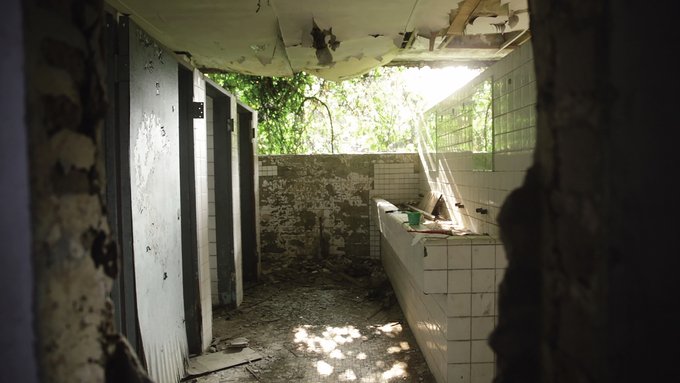
“Are you dizzy?” the staff member asked again after Bloodless ended, checking if I wanted to continue on to Tearless. Perhaps some viewers pause or even step away here. I later learned from director Gina Kim that some viewers instinctively lift their feet during the climax of Bloodless. Tearless, however, soon subdues the fear with grief.
In the early 1970s, in an effort to reduce the rate of sexually transmitted infections among U.S. troops, the South Korean government built a detention and treatment facility for “comfort women” at the base of Soyosan. After the opening credits, the film begins in a stark contrast to Dongducheon’s neon-lit streets—an extremely dark and damp ruin. When shooting in 2020, Kim reported that the site was filled waist-high with remnants of the past and piles of unidentified garbage. Over this space, she overlays images of the past. Military beds, doorless showers, and operating tables appear and dissolve into view. Some presences emerge only in sound.
Though each decaying image evokes loneliness on its own, Tearless doesn’t linger merely on the visual. Instead, it inscribes the presence of those who once existed there, evoking the layered history embedded in the ruin. The disembodied footsteps from Bloodless turn into ghostly wails here, which swell into the sound of heavy rain. The daily schedule of the 1970s detention facility included no time for crying, but Tearless makes room for it.
COMFORTLESS / 2023

After wandering through rooms filled with sorrow, fear, and shame, I was briefly pulled back out into the bright streets of day - just like the opening of Bloodless. This time, the scene is American Town, built in 1969 near the U.S. Air Force base in Gunsan. In 2018, the South Korean High Court officially recognized the term “U.S. military comfort women” in a ruling that required the government to compensate survivors of the detention facilities. Gina Kim, who built historical realism through temporal shifts and hallucinations in the first two films, continues this approach in the final chapter of the trilogy.
What did American Town look like in 2022, when the footage was shot? In a word: empty. But as night falls, lively images ripple across closed storefronts, broken mirrors, and cracked tables. Though the viewer is immersed in a single virtual world, the sensation of overlapping time and space intensifies when watching the trilogy in succession.
The common verb associated with VR cinema is “to experience.” In Gina Kim’s films, that experience may feel like “becoming a victim” or “becoming a ghost.” But Kim herself refutes this: “That’s simply not possible,” she says. My impression after watching the entire trilogy is that it creates a meaningful surreality not by erasing temporal gaps or the limits of otherness, but by preserving them. The experience is not about pretending to become someone else or feeling ghostly sorrow—it is about bearing the heavy weight of the silence we’ve kept for far too long.